(E-E) E.v.g.e.n.i.j ..K.o.z.l.o.v Berlin |
|
home // E-E // biographie // art // eros // Leningrad 80s // Valentin Kozlov // 2 x 3m // events // lageplan // kontakt /
 / |
(E-E) E.v.g.e.n.i.j ..K.o.z.l.o.v Berlin |
|
home // E-E // biographie // art // eros // Leningrad 80s // Valentin Kozlov // 2 x 3m // events // lageplan // kontakt /
/ |
(E-E) Evgenij Kozlov
|
|||||||||||||
|
|
|||||||||||||
|
St. Petersburg Archive and Library of Independent Art, Pushkin street 10, St. Petersburg
Петербургский архив и библиотека независимого искусства, Пушкинская 10, Ст. Петербург 29 July 2000 |
|||||||||||||
|
Curated by: Andrey Khlobystin, artist and director of the Petersburg Archive and Library of Independent Art (1999-2007) Evgenij Kozlov, artist and collector (Collection "2x3m") Hannelore Fobo, curator and independent researcher |
|||||||||||||
|
|
|||||||||||||
| Hannelore Fobo, 2020 (revised 2025) St. Petersburg Archive and Library of Independent Art (PAiBNI) (2000-2007) |
|||||||||||||
 |
|||||||||||||
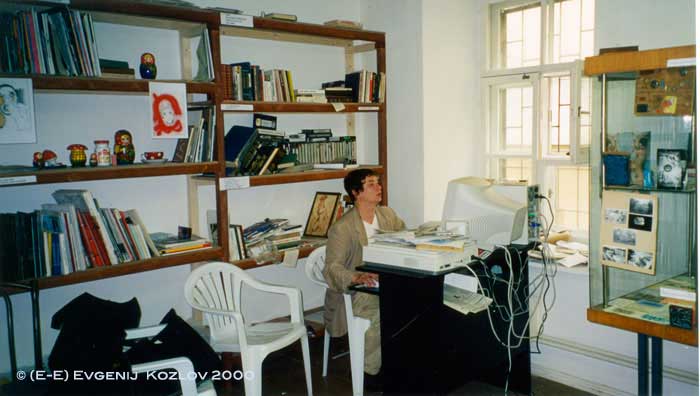
Andrey Khlobystin, director of the Petersburg Archive and Library of Independent Art. Photo: (E-E) Evgenij Kozlov, 2000
|
|||||||||||||
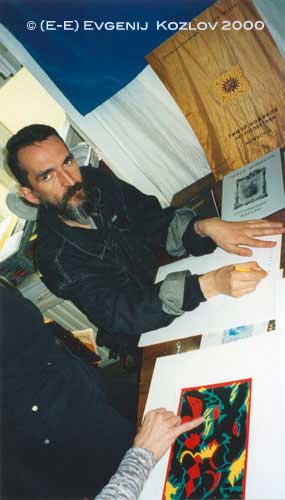
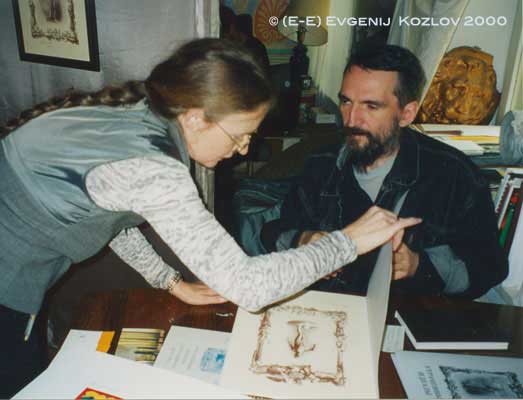
| “E-E” Cult Heroes of the 1980s took place at St. Petersburg Archive and Library of Independent Art (PAiBNI = ПАиБНИ, Петербургский архив и библиотека независимого искусства), an institution initiated by artist and art-historian Andrey Khlobystin in 1999 at Pushkinskaya 10 Art Center, Saint Petersburg External link >>. It was, in a sense, a “return” exhibition after Khlobystin’s solo show “Great Lovers” at Kozlov’s Berlin studio “Russkoe Polee / The Russian Field 2” in 1996 External link RAAN >>.
What is more, an exhibition of Kozlov’s private archive perfectly fitted the concept of Khlobystin’s pioneering enterprise. Khlobystin described his ideas and the difficulties he encountered in his article St. Petersburg Archive and Library of Independent Art. The Experience of Total Archiving, published on the website of RAAN, the Russian Art Archive Network, on 20 October 2020:
[…] In 2007, St. Petersburg Archive and Library of Independent Art was closed by the administration of Pushkinskaya 10 for “lack of seriousness.” […] St. Petersburg Archive and Library of Independent Art was probably founded too early, and its activity did not extend to its young audience. Real interest in the 1980s and 1990s only appeared in the 2010s. Nevertheless, the archive helped to conserve the heritage and spirit of the time of change, support traditions, and develop the self-awareness of St. Petersburg’s art. […] From fall 2000 to spring 2007, St. Petersburg Archive and Library of Independent Art organized 88 exhibitions, including 75 exhibitions on its own premises. Andrei Khlobystin: St. Petersburg Archive and Library of Independent Art. The Experience of Total Archiving. External link RAAN >>
Eighty-eight exhibitions in seven years speak of an impressive succession of projects – about one every month. Khlobystin refers to fall 2000 as the beginning of his exhibitions activities at PAiBNI, but it must have been a little earlier, since “E-E” Cult Heroes of the 1980s” took place on 29 July 2000. In his “description of some of the most important projects in chronological order” (in the article quoted above), Khlobystin lists “E-E” Cult Heroes of the 1980s” after Vadim Ovchinnikov’s Mail Art and Samizdat Forever (with Navicula Artis Gallery). This would make it the third PAiBNI exhibition.
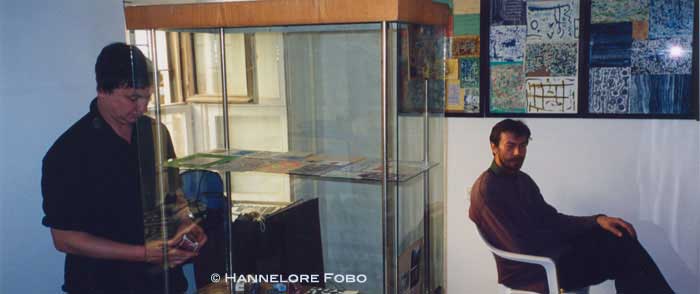
Although the PAiBNI premises were indeed rather small, the exhibition space was somewhat more generous than that provided by the walls of “a tiny room, barely bigger that Rodion Raskolnikov’s closet” – in other words, by the vestibule leading from the corridor outside to Khlobystin’s office. The office room had one continuous wall of about five metres length, which became the main wall for the presentation of Kozlov’s contact sheets, although we used that “closet” space, too. A glass cabinet and a table covered with a glass plate offered additional space for photographs and reproductions of Kozlov’s works. But that was not all, at least not in principle. Referring to the exhibition Samizdat Forever Khlobystin writes: “The corridor where the archive was located was used for an exhibition of materials on the history of samizdat.” We used that space for the gathering of visitors.
To no small degree, disadvantages originating from lack of exhibition space were compensated by the venue, Pushkinskaya 10 Art Center, the heart of St. Petersburg’s art community run by the Association “Free Culture” (Товарищество “Свободная культура”). With its café and concert hall (Fish Fabrique), artists’ studios, museums and a number non-commercial galleries, Pushkinskaya 10 served as a hub for the exchange of information on the local and international art-scenes. Being an artist as well as an art-historian, Andrey Khlobystin had himself an excellent network of national and international contacts. It helped him to follow current issues within the art world and to distinguish from general practices what was particular for the Leningrad / St. Petersburg art-scene.
Among those “Pushkinskaya 10” galleries was the “Museum of the New Academy of Fine Arts”, that is, the gallery of Timur Novikov’s “New Academy” art group, where Khlobystin held the office of a Secretary. Khlobystin’s list of PAiBNI exhibitions mentions several projects carried out together with the New Academy, for instance Abstractionism in Russian Caricatures of the 20th Century, accompanied by a handmade catalogue. During the exhibition “E-E” Cult Heroes of the 1980s”, Evgenij Kozlov and I paid Novikov a visit at the New Academy and exchanged gifts with him: Kozlov gave him two of his silkscreen prints from his “New Classicals” series, and Novikov gave us his set of gum bichromate prints from the series “Lost Ideals of a Happy Childhood”.
 Surely the St. Petersburg Archive and Library of Independent Art was no archive in the classical sense of an institution – there was no permanent staff classifying objects to make the information available to researchers – but it was an archive in the sense of presenting objects deserving our attention because of their “communicative” quality – objects that might otherwise be overlooked. Giving a description of the basic principle of the PAiBNI, Khlobystin explains:
благодаря тебе я заметил, что в переводе моего текста в RAAN допущена ошибка: во фразе "Для меня тогда искусством стало общение — созвучное словам «общее» и «сообщение»" - переведено, как "I began to see art as communication, which is linked to the words “common” and “communal", то есть - "сообщение" почему-то переведено, как “communal", что неверно. Наверное, надо написать "message" How exactly such a connection to the “database” takes place we are not told, but different possibilities occur. For instance, we may consider a work of art to possess for us a sign quality – in this case it would act as a placeholder for a specific “element” creating the noosphere. Or we may think that indeed a “fraction” of the noosphere is a constituent of that particular (art) object which thus communicates with us directly. The difference between these two concepts is not unimportant: in the first case, we would speak of communication leading us to a reminiscence of and a reflection about what has already happened and has entered noosphere, while in the second case we might speak of communication as a process affecting and transforming our inner state. Here, communication becomes Communion – transubstantiation as sacrament or mystery – with the difference only that communicating with an object in a museum does not require a specific ritual carried out by a priest. Of course, if we are inclined to support that second concept, then the question arises whether all objects serve the purpose of Communion in equal measure.[1]
Regarding the selection of “phenomena, objects, and energies”, Khlobystin promoted the idea of looking for any such objects representing “the spirit of the time of change”:
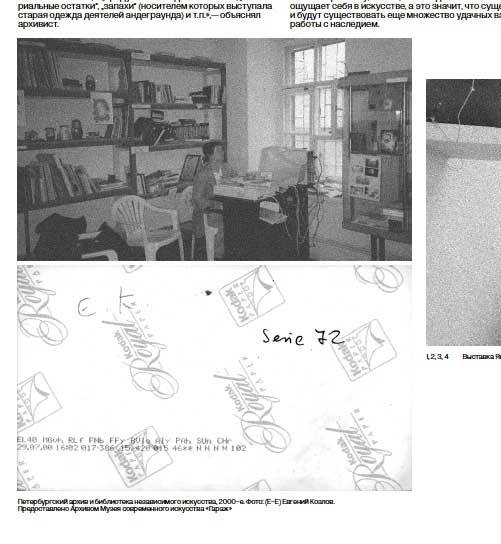
That approach was perhaps too eccentric or outlandish even for an “alternative” institution such as the Association “Free Culture”, having itself emerged from Leningrad’s non-official art-scene. In this respect, Khlobystin might have been ahead of his time, although he collected classical – printed and handwritten – archival goods, as well. As a matter of fact, the idea of a classical, yet independent Russian art archive was in the air: in 2012, Moscow-based Garage Museum of Contemporary Art “began building an archive on the history of Russian contemporary art, which currently holds the world’s largest collection of materials on Soviet and Russian art of the postwar era.” External link RAAN >>. In 2017, the Garage Archive Collection started publishing its database as a primary source for online research, and together with its partner institutions – the Zimmerli Art Museum (Rutgers University, USA) and the Research Centre for East European Studies (University of Bremen, Germany) – created the already mentioned Russian Art Archive network (RAAN). It is therefore only logical that a large number of those documents Khlobystin had meticulously collected over the course of twenty-five years entered the Garage Archive Collection some years ago. The “Andrei Khlobystin Archive” yields more than 1000 results, mostly articles, magazines, posters, invitation cards and photographs External link RAAN >>. Among these items are my own photographs, for instance, several pictures I gave Andrey Khlobystin of his visits to Kozlov’s Berlin studio “The Russian Field 2” External link RAAN >>, but also two of Kozlov's pictures from the exhibition “E-E” Cult Heroes of the 1980s External link RAAN >>, each published front and reverse. In February 2025, Центр художественного производства «Своды» / Art Production Center "Vaults" (Moscow) published a magazine dedicated to the subject of Xранение – Архивы в современном искусстве / Storing – Archives in Contemporary Art, featuring institutional concepts and private initiatives. It includes Yana Sindorkina's article on Khlobystin's Petersburg Archive and Library of Independent Art, presenting it with one of Kozlov's pictures from the RAAN homepage that is also published at the top of this page. |
|||||||||||||
 |
|||||||||||||
E-E Kozlov's picture printed front and reverse in the magazine Своды A2 – Xранение, (Vaults A2, Storing), 2025, p. 15 |
|||||||||||||
|
Interestingly, the editors also printed the reverse of this picture as it provides additional information: the company that printed the picture (Kodak), the date and time it was taken (29.07.00 at 16:02) plus other technical information, and, most importantly, my handwritten notes. "E.K" stands for Evgenij Kozlov, the photographer, and "Serie 72" indicates that in my own archive, it is part of colour film number 72. In this way, one archive refers to another archive, and the thread can be continued backwards. Hannelore Fobo, 2020 (revised 2025) [1] I t would be interesting to compare the notion of noosphere with that of akasha, as used by Theosophy and Anthroposophy, respectively — negative matter, the basis for the world memory. External link AnthroWiki >> |
|||||||||||||
| Uploaded 14 April 2025 |
|
home // E-E // biographie // art // eros // Leningrad 80s // Valentin Kozlov // 2 x 3m // events // lageplan // kontakt /
|